How can I build a multi-lingual sales team for international growth?

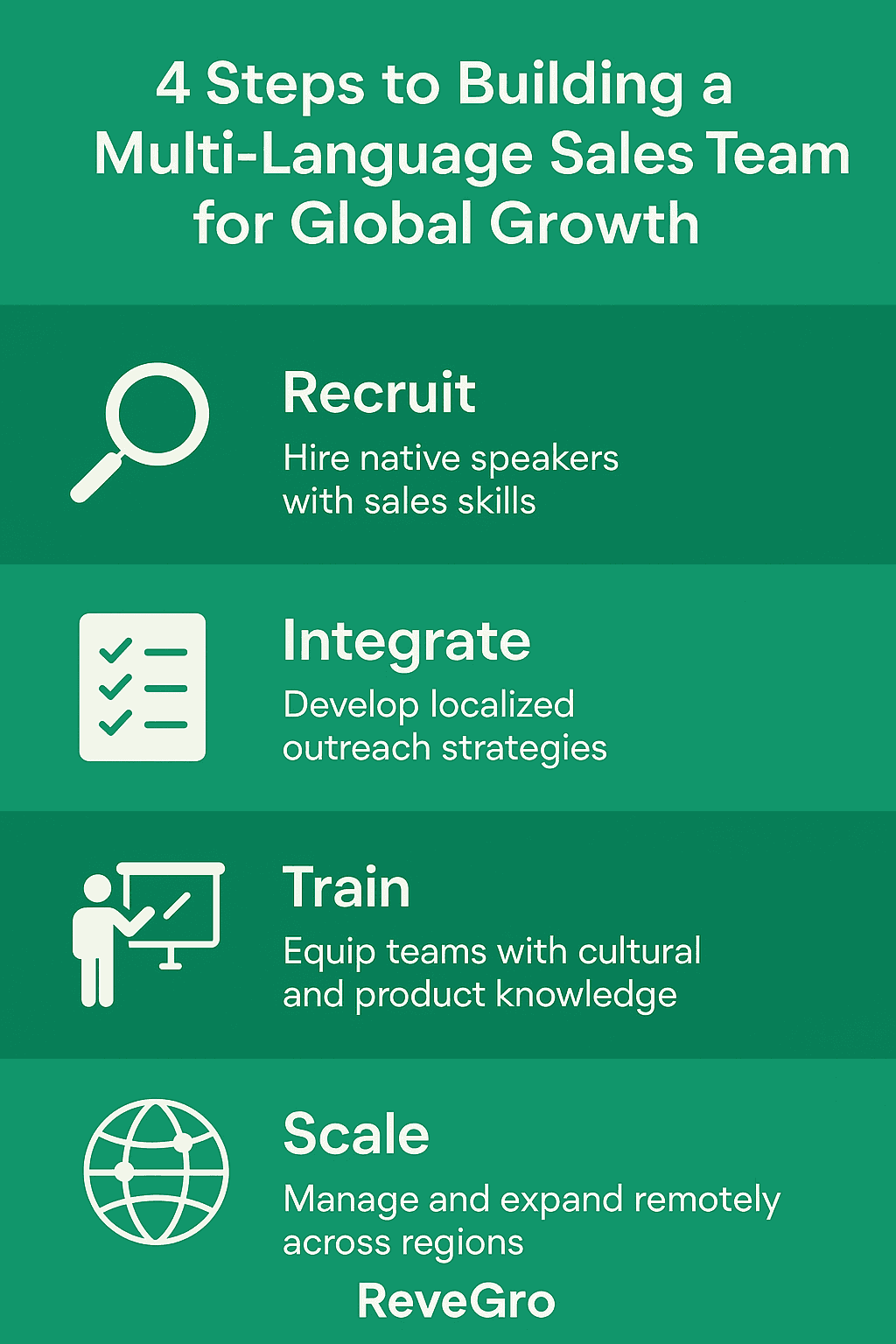
To grow internationally, focus on building multi-language sales teams by recruiting native speakers, integrating localised outreach, training them on your market and product, and scaling via remote management.
This approach drives faster pipeline growth in key regions like Europe, LATAM, and APAC.
Why Multi‑Language Sales Teams Matter for Global Growth
Native-language engagement builds trust and rapport more quickly.
Cultural fluency enables representatives to handle local objections effectively.
Regional targeting unlocks new sales motions in untapped markets.
Companies that use this strategy often see conversion rates 20–30% higher on regional campaigns.
Brands expanding beyond their home market frequently struggle without properly tailored sales efforts. That’s where multi-language sales teams make a difference—turning leads into loyal customers faster.
What Happens Without Native-Language Outreach?
Your message may come across as generic or tone-deaf across cultures.
Missed responses from prospects who prefer native-language communication.
Competitive disadvantage in countries like France, Germany, Spain, and Brazil.
Scaling beyond English-speaking regions becomes slow and reactive.
What Advantages Do Multi‑Language Sales Teams Offer?
1. Higher Conversion Across Borders
Speaking in a prospect’s native language immediately boosts engagement and credibility.
2. Culturally-Informed Sales Tactics
Local representatives understand regional nuances, from pricing sensitivities to compliance requirements.
3. Tailored Messaging for Each Region
From lead magnets to discovery calls, every touchpoint is localised for maximum impact.
4. Faster Deal Cycles
Native-language communication simplifies negotiation and speeds up closure timelines.
What Roles Should Your Multi‑Language Team Include?
Role | Responsibility | Language Focus |
SDRs | Cold outreach, lead qualification | German, French, Spanish, etc. |
BDRs / AMs | Pipeline nurturing and deal closing | Native-language engagement |
Sales Manager | Oversight, coaching, performance tracking | Bilingual or multilingual |
A well-structured multilingual team ensures that lead generation and deal execution are both culturally and linguistically aligned.
In‑House vs Freelancer vs Outsourced Sales Team for B2B
Model | Time to Launch | Cost | Language Quality | Management Overhead |
In-House Hires | Slow | High | Very High (if hired well) | High |
Freelancers | Fast | Low–Medium | Variable | Medium |
Outsourced Sales Team for B2B | Fast | Medium | Consistent, Vetted | Low (with provider support) |
In-house hires offer control but are costly and slow to onboard.
Freelancers are quick, but quality and continuity can suffer.
An outsourced sales team for B2B growth provides scalable, language-native talent with built-in processes, perfect for lean international scaling.
How to Recruit and Vet Multilingual Sales Talent
1. Test Cultural and Language Fluency
Role-play international calls and read/write scenarios in the native tongue.
2. Practical Skills Assessment
Request sample cold emails in the target language and a mock pitch to assess proficiency.
3. Compliance and Remote Work Readiness
Ensure proper contracts, tax setups, and remote tools are in place.
4. Native-Language Onboarding
Equip teams with localised materials and context to drive better regional performance.
Managing Remote Sales Teams Europe and Beyond
Essential Tech Stack
CRM with language-specific tagging and dashboards
Recording tools (e.g., Gong) with native-language transcription
Regional communication channels (Slack/MS Teams by language group)
Standardised, Localised Playbooks
Create email, call, and demo scripts tailored to each country.
KPIs by Region
Analyse performance by market: leads booked, demos, and conversion rates.
Coaching and Quality Assurance
Conduct call reviews and feedback sessions in each native language to ensure consistency and maintain skills.
How to Launch with a Lean Lingual Sales Blueprint
Prioritise regions based on addressable market and product fit
Create outreach cadences per language (calls + emails + LinkedIn touches)
Pilot with outsourced teams, targeting two or three languages simultaneously
Measure KPIs after 60 days: response rates, demos booked, pipeline buildup.
Scale successful campaigns and gradually add new language markets
This phased approach avoids heavy investment until the strategy is proven to work.
How ReveGro Empowers Global Sales Growth
ReveGro excels in delivering scalable, native-language sales capabilities:
Multilingual SDR provision: Fluent in German, French, Spanish, Italian, and more.
Remote Sales Teams Europe and beyond: Operates from UK, Spain, and Singapore offices for global reach.
Outsourced Sales Team for B2B excellence: Full-time SDRs, playbook-driven, plug-and-play model integrates with your roadmap.
Cloud-enabled collaboration: CRM setup, team leads, KPI tracking, and monthly insight reports ensure performance and alignment.
Which KPIs Should You Track for Multi‑Language Sales Teams?
To accurately assess performance across language-specific markets, monitoring a regional KPI framework ensures consistent, data-driven growth.
Key Metrics to Measure by Language/Region
Conversion Rate / Win Rate per Region - Tracks how many opportunities turn into closed deals in each language market.
Sales Cycle Length by Territory - Measures the average time from initial outreach to deal closure.
Pipeline Velocity - Combines win rate, average deal size, and sales cycle length to gauge how quickly revenue is generated per market.
Activity Metrics by Language Group
Track regional performance in:
Calls or messages sent
Meetings booked
Demos held
Lead response time
Lead Conversion Rates per Stage - Monitor conversion from MQL to SQL, SQL to opportunity, and opportunity to close separately for each language team.
Average Deal Size & ACV by Region - Track the average contract value and revenue per closed deal, as it may vary significantly across markets.
Why Segmented KPIs Matter
Reveals performance disparities between language markets, enabling targeted training or adjustments
Helps forecast revenue more accurately by considering market-specific sales cycle velocity
Supports data-driven decisions for expansion strategies
Aligns cross-region teams toward unified OKRs, fostering clarity and accountability
Scale Globally with Language-Powered Sales
International growth demands more than translation; it requires cultural resonance, native communication, and regional expertise.
Whether through in-house hires, freelancers, or an outsourced sales team for B2B, the goal remains the same: to build trust, engage meaningfully, and close deals more efficiently.
For companies targeting new territories, launching with remote sales teams in Europe or beyond delivers speed, scale, and authenticity.
When you’re ready to go global profitably, consider RevelGro’s turnkey solution, designed to scale international pipelines without the overhead or delay.
FAQs
What’s the easiest way to launch a multilingual sales function?
Start with a pilot campaign using an outsourced sales team for B2B services. Fast onboarding and proven processes mean you’re selling in new languages within weeks.
Do I need local hires in each country?
No. Remote sales teams in Europe and nearby regions can cover outreach and pipeline generation without local offices, saving cost and complexity.
How long does onboarding take?
Typically 2–4 weeks, including training, tech setup, and playbook familiarization.
Which languages deliver best ROI?
Begin with the top markets: German, French, Spanish. Once those prove results, consider expansion to Italy, Dutch, Portuguese, etc.
How do I evaluate multilingual SDR performance?
Track language-specific KPIs: booked meetings, conversion rates, average deal size. Compare across regions for insights.