How Do Buying Groups Affect B2B Sales Outcomes?

In many B2B sales processes, engagement still begins with a single contact.
A decision-maker
A champion
A point of entry into the organisation
However, this rarely reflects how decisions are actually made.
Most B2B purchases, particularly those involving higher value or complexity, are made by groups of stakeholders, each with different priorities, concerns, and responsibilities.
Focusing on a single contact may initiate a conversation, but it rarely determines the outcome.
Understanding and engaging the buying group as a whole is what ultimately shapes whether opportunities progress.
Key Takeaways
B2B decisions are made by groups, not individuals
Each stakeholder evaluates opportunities from a different perspective
Engagement that focuses on a single contact often limits progression
Alignment across the buying group is critical to conversion
AI can support visibility into stakeholders, but not replace judgement
Strong outcomes depend on understanding, coordination, and timing
What Is A Buying Group In B2b Sales?
A buying group refers to the collection of stakeholders involved in evaluating and approving a purchase.
This typically includes:
Commercial decision-makers
Operational stakeholders
Technical evaluators
Procurement or finance representatives
Each plays a different role in the process.
Some focus on value and outcomes
Others assess feasibility or risk
Others evaluate cost and compliance
The result is that decisions are not linear.
They are collective and often complex.
How Buying Groups Influence Sales Outcomes
The presence of a buying group changes how opportunities develop in several ways.
Decisions become more complex
Each stakeholder introduces:
additional requirements
different priorities
varying levels of influence
This increases the time and coordination required to reach a decision.
Research from Gartner indicates that the average B2B buying group now involves 6 to 10 stakeholders, each bringing their own perspective to the decision-making process.
This makes alignment a central challenge in progressing opportunities.
2. Alignment becomes more important than persuasion
In simpler sales environments, success may depend on convincing a single decision-maker.
In more complex environments, success depends on:
aligning multiple stakeholders
addressing different concerns
creating a shared understanding of value
Without this alignment, opportunities often stall, even when initial interest is strong.
3. Internal consensus shapes outcomes
Stakeholders within the buying group must:
agree on priorities
align on risk
justify the decision internally
This internal process often happens without direct supplier involvement.
As a result, opportunities can progress or fail based on discussions that are not visible externally.
4. Engagement becomes non-linear
Engagement rarely follows a predictable sequence.
Different stakeholders may:
enter the process at different stages
engage at different levels of depth
influence decisions in indirect ways
This makes it difficult to manage opportunities through a simple, linear sales process.
Why Many B2B Sales Efforts Struggle With Buying Groups
Despite their importance, buying groups are often not fully understood or engaged.
Common challenges include:
Over-reliance on a single contact
Teams often focus on:
● the initial point of engagement
● the most responsive stakeholder
This creates a narrow view of the opportunity.
2. Limited visibility into stakeholders
Without structured insight, it can be difficult to:
identify all relevant stakeholders
understand their roles and priorities
This limits the ability to engage effectively.
3. Inconsistent messaging
Different stakeholders receive:
different information
varying levels of context
This can lead to misalignment within the buying group.
4. Lack of coordination
Engagement is often:
fragmented across teams
reactive rather than planned
This makes it harder to build alignment across the group.
What Changes When Buying Groups Are Understood More Clearly
Organisations that engage buying groups effectively tend to take a more structured approach.
Stakeholder mapping becomes part of the process
Rather than relying on a single contact, teams:
identify key stakeholders early,
understand their roles and influence
2. Engagement is tailored to different perspectives
Communication reflects:
commercial priorities
operational concerns
risk considerations
3. Alignment is built intentionally
Rather than relying on internal discussions, teams:
support alignment across stakeholders
provide consistent and relevant context
4. Opportunities are managed as systems, not interactions
Focus shifts from:
individual conversations
to:
coordinated engagement across the buying group
How AI Supports Buying Group Engagement
AI can play a role in improving how buying groups are understood and engaged.
Identifying stakeholders
AI can help surface:
relevant decision-makers
influencers within the organisation
2. Providing account-level insight
Structured intelligence can support:
understanding of organisational context
visibility into potential priorities
3. Supporting more consistent engagement
AI can help ensure that:
insight is shared across teams
messaging remains aligned
Platforms such as Limitless support this by enabling teams to:
build structured understanding of accounts
identify stakeholders
prepare for engagement with greater context
The objective is not to automate relationships, but to support more informed and coordinated engagement.
How Buying Group Engagement Changes B2B Outcomes
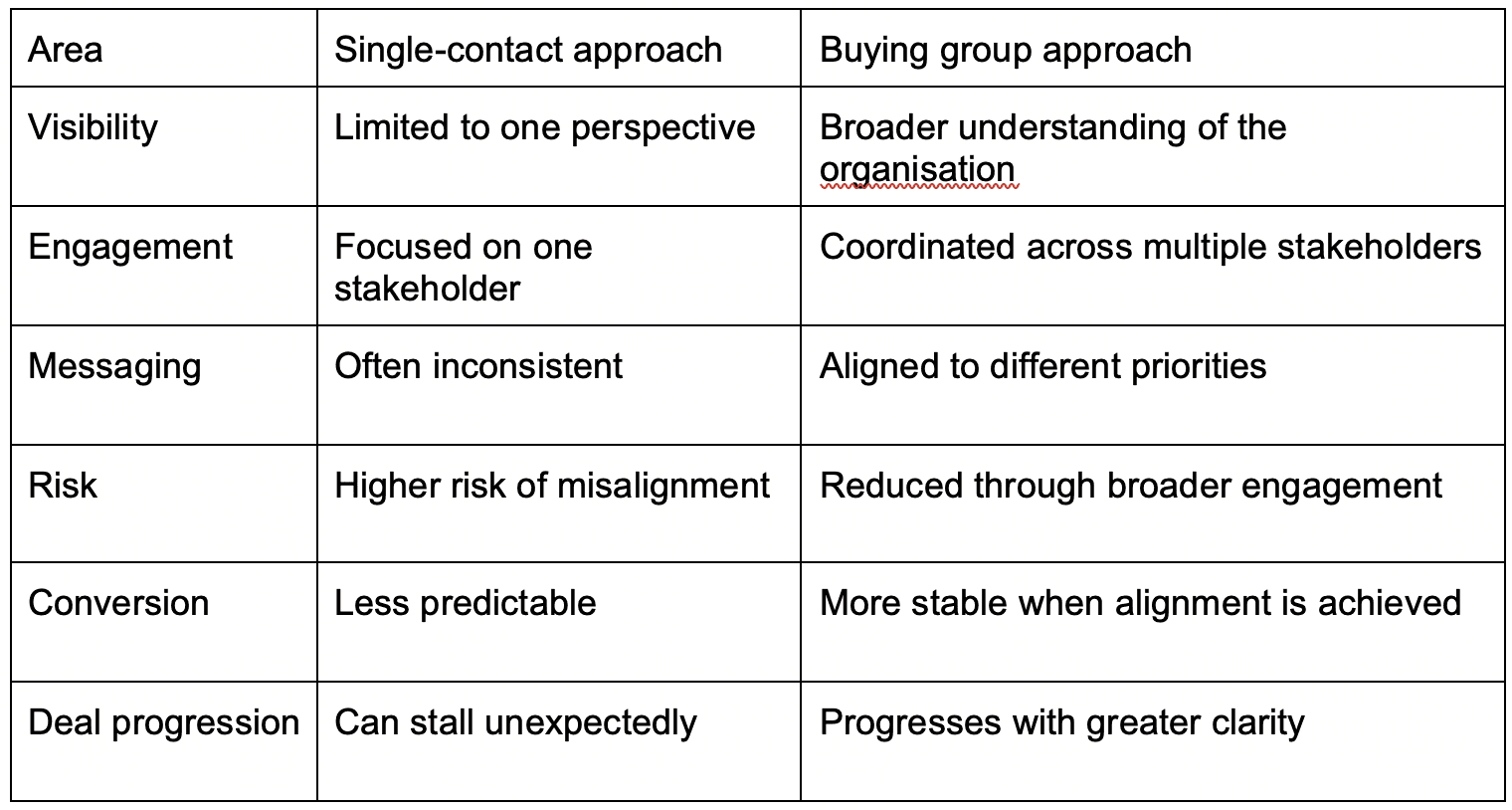
A More Useful Way To Think About B2B Sales
B2B sales are often approached as a series of interactions with individuals.
In practice, it is a process of:
understanding organisations
engaging groups of stakeholders
building alignment over time
Buying groups are not an obstacle.
They are a reflection of how decisions are made.
Recognising this allows organisations to move from:
reactive engagement
to:
structured, coordinated pipeline development
For organisations looking to improve sales outcomes, it is often useful to assess:
How clearly buying groups are identified
How consistently stakeholders are engaged
How well messaging reflects different priorities
How effectively insight is shared across teams
If you are exploring how to strengthen engagement across buying groups, you can book a conversation with the ReveGro team to assess where greater structure and alignment could improve outcomes.
FAQs
What is a buying group in B2B sales?
A buying group is the set of stakeholders involved in evaluating and approving a purchase, each with different roles and priorities.
How many people are typically involved in a B2B buying decision?
Research suggests that most B2B buying groups involve between 6 and 10 stakeholders.
Why do buying groups make sales more complex?
Because decisions must align across multiple perspectives, including commercial, operational, and financial considerations.
How can you engage a buying group effectively?
By identifying stakeholders early, understanding their roles, and ensuring communication is relevant and aligned.
Can AI help with buying group engagement?
AI can support stakeholder identification and provide insight, but effective engagement still depends on human judgement and coordination.