What Do Investors Look for in B2B Companies from a Sales Perspective?

Investors back B2B companies with scalable, efficient sales engines. Learn what metrics, models, and strategies make your sales team truly investor-ready.
Key Takeaways
Scalability equals confidence: Investors fund B2B firms whose sales models grow revenue faster than costs.
Metrics matter most: KPIs like CAC-to-LTV, churn, and pipeline-to-quota prove sustainable, investor-grade growth.
Hybrid sales teams win: Blending in-house and outsourced talent drives efficient, scalable expansion.
Churn and international reach impact valuation: Retention and global revenue diversity reduce perceived risk.
Sales excellence boosts enterprise value: A repeatable, data-driven sales engine directly increases business valuation.
Investors in B2B firms look first and foremost for a scalable, predictable sales engine that delivers repeatable, high-quality revenue, low churn, and improving margins because that combination signals real growth potential and reduced risk.
Why Do Investors Prioritise Scalable Sales Models in B2B Companies?
What Does “Scalable” Mean in a B2B Sales Context?
Scalability means a sales model that grows revenue without costs or head-count increasing at the same pace. It’s built on:
repeatable processes and proven playbooks
automation and data-driven decisions
geographic or segment expansion using a consistent model
A scalable system gives investors confidence that growth isn’t dependent on chance or individual performance.
According to McKinsey, B2B organisations with scalable sales engines outperform peers by 10 %+ annual growth in market share.
How Does Scalability Reduce Investor Risk?
A scalable sales engine:
reduces reliance on founders or “hero” sellers
provides predictable forecasting and margins
shows potential for operating leverage higher revenue with steady cost base
What Are the Warning Signs of a Non-Scalable Model?
Investors become cautious when they see:
growth tied to single individuals
lack of documented process or CRM discipline
head-count growth matching revenue growth
minimal automation or outsourced leverage
Which Sales KPIs Prove to Investors That Growth Is Sustainable?
What Metrics Do Investors Consider Most Reliable?
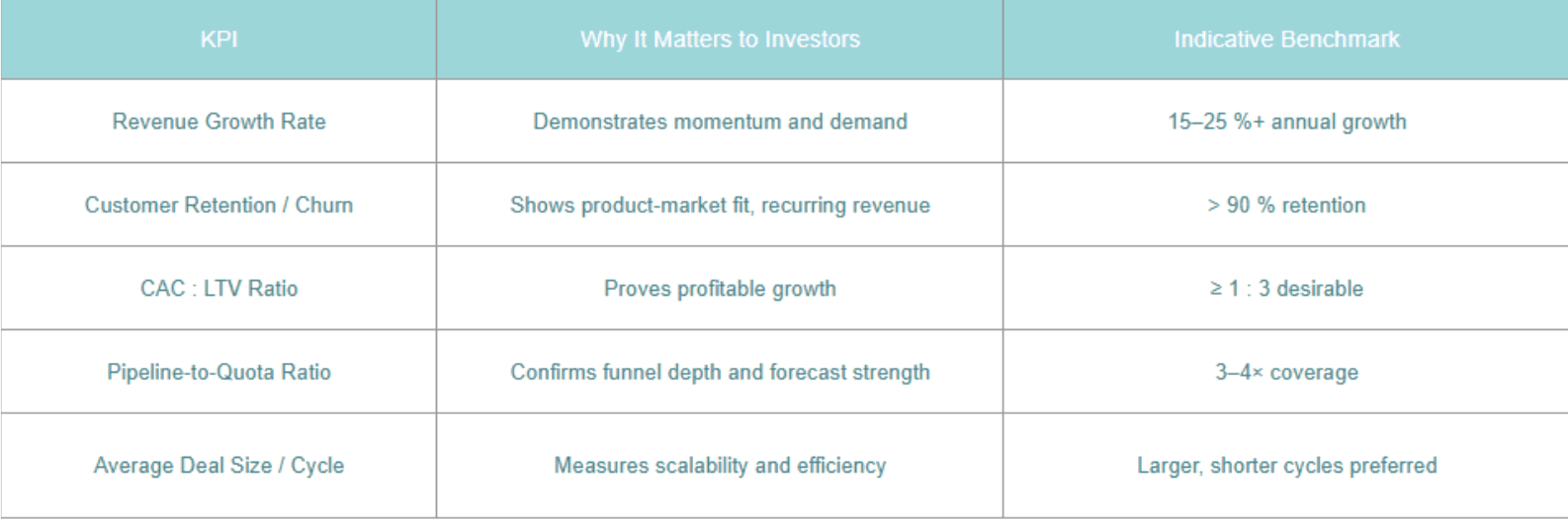
Key indicators that show your sales growth is durable include:
Revenue Growth Rate – proves market demand and execution.
Customer Retention / Churn Rate – measures stability of recurring revenue.
Customer Acquisition Cost (CAC) vs Lifetime Value (LTV) – reveals profitability of scaling.
Pipeline-to-Quota Ratio – forecasts sales momentum.
Average Deal Size & Sales Cycle Length – indicates efficiency and scalability.
Forecast.io reports that average win rates in B2B sales hover between 20 % and 30 %, highlighting how vital a well-structured pipeline is.
What KPI Benchmarks Help Build Investor Confidence?
How Should B2B Firms Present KPIs to Investors?
Highlight trend data, not snapshots.
Tie improvements to operational actions (automation, process optimisation).
Show how KPIs map to valuation levers: growth, margin, recurring revenue.
How Do Investors Evaluate Outsourced vs In-House Sales Models?
Why Might an Outsourced Sales Model Appeal to Investors?
Because it offers:
faster market entry or expansion
lower fixed-cost base
multilingual or regional coverage (e.g., Europe)
measurable pipeline growth without additional hiring
What Risks Do Investors Examine in Outsourcing?
Control over customer relationships and data
Alignment of brand tone and quality
Dependency on external vendors
How Does the In-House Model Compare?
In-house teams offer ownership and culture alignment but increase fixed costs. Investors will assess productivity metrics and ROI per sales rep to ensure efficiency.
How Do Investors Decide Between the Two Models?
They compare CAC, win rate, churn, and scalability. Hybrid approaches with an internal core with outsourced extensions often attract the strongest investor confidence.
How Does Customer Churn Influence Investor Risk Perception?
Why Is Churn a Critical Signal for Investors?
High churn undermines recurring revenue, suggesting poor fit or value delivery. For investors, this means higher acquisition cost to maintain revenue and greater uncertainty about future earnings.
What Retention Rates Do Investors Consider Healthy?
While industry benchmarks vary, retention above 90 % and net revenue retention above 100 %
(including upsells) show a stable, expanding customer base.
What Strategies Help Reduce Churn and Impress Investors?
Strong onboarding and customer success management
Proactive engagement and expansion within existing clients
Value-driven product updates informed by feedback
Clear linkage between client outcomes and renewals
Why Does International Revenue Strengthen Investor Confidence?
What Does Global Revenue Reveal About a Company?
It shows market diversification, scalability, and operational maturity all indicators of lower investment risk.
Which Metrics Do Investors Review for International Success?
Percentage of total revenue from overseas markets
International growth rate vs domestic
Multilingual or regional sales teams
Localisation efficiency and compliance readiness
How Can B2B Companies Demonstrate International Readiness?
Regional customer success and support presence
Adapted go-to-market strategies for local markets
Documented compliance frameworks
Partnerships enabling cost-effective entry
How Does Global Reach Affect Valuation?
International diversification broadens the total addressable market and enhances exit multiples particularly for firms expanding predictably into Europe or Asia.
How Can B2B Companies Grow Their Sales Pipeline Without Hiring More Staff?
What Defines “Growth Without Hiring”?
Growth achieved through:
automation and AI for lead generation / B2B lead qualification AI
process optimisation
outsourcing or remote sales teams
performance-based vendor partnerships
Why Do Investors Reward This Efficiency?
It proves management can expand pipeline and revenue while protecting margins, evidence of scalability and capital discipline.
How Should Companies Demonstrate This Capability?
Show pipeline velocity and conversion gains.
Quantify cost-per-lead improvements from automation.
Illustrate how outsourcing opened new markets without payroll expansion.
What Enterprise-Sales Capabilities Do Investors Expect from SMEs?
Why Are Enterprise Deals Attractive to Investors?
Enterprise clients bring predictable, high-value contracts and credibility.
McKinsey reports that enterprise-level deals can represent 40–60 % of total potential B2B revenue in growth-focused companies.
How Can SMEs Prove Enterprise-Sales Readiness?
Dedicated account-management structure
Value-based selling across multiple stakeholders
Documented case studies and reference clients
Governance for renewals and multi-year contracts
What Evidence Should You Present to Investors?
Pipeline mix showing larger deal sizes
Win-rate improvements in enterprise segment
Shortened sales cycles or higher expansion revenue
Mature processes for long-term enterprise retention
How Does Sales Excellence Translate into Higher Business Valuation?
Why Is Sales Performance Directly Linked to Valuation?
Because consistent, scalable revenue demonstrates durable earnings and lower risk driving higher EBITDA multiples and investor appetite.
Which Sales Strategies Increase Valuation Most?
Standardised, documented sales processes
Smart automation and outsourcing for scale
International expansion into new markets
Enterprise deal focus and higher lifetime value
Strong ESG and purpose alignment for modern investors
What Do Investors Ask During Sales Due Diligence?
How predictable is your revenue pipeline?
What are your churn, CAC, and expansion rates?
What cost is required to scale in the next 3–5 years?
How is sales performance tied to long-term value creation?
How Does ReveGro Help B2B Companies Meet Investor Expectations?
Scalable Systems: ReveGro builds repeatable sales playbooks and automation frameworks that allow revenue to scale faster than cost.
KPI Discipline: We help define, track and improve the exact metrics investors evaluate.
Hybrid Growth Models: Our multilingual, outsourced, and remote sales teams deliver sales pipeline growth without hiring.
Global Expansion: With a footprint across the UK, Spain, and Singapore, we help clients sell into Europe and beyond.
Enterprise & Exit Readiness: We equip SMEs with enterprise-grade sales infrastructure, ESG integration, and valuation-focused growth strategies.
ReveGro blends strategic advisory with hands-on execution helping B2B companies transform sales capability into measurable investor confidence.
Wrapping Up!
For investors, sales performance is the clearest window into a company’s future value. The most attractive B2B firms combine:
Scalability – revenue rising faster than cost.
Sustainability – retention, recurring revenue, and margin stability.
Efficiency – pipeline growth without constant hiring.
Global Reach – diversified markets and opportunity.
These qualities reduce perceived risk and justify higher valuations.
Ultimately, investors back evidence, not ambition. A B2B company that can show a repeatable sales engine, robust metrics, and a credible plan for expansion isn’t just running a business it’s building an asset with enduring value.
FAQs
Why do investors prioritise scalable sales models?
Because scalable models grow revenue without proportional cost, reducing execution risk and improving margins.
What KPIs best prove sustainable growth?
Revenue growth, retention, CAC-to-LTV, pipeline coverage, and deal size all indicate a healthy, investable sales engine.
How do investors compare outsourced and in-house sales teams?
They assess which approach yields superior efficiency, scalability, and retention; hybrid models often balance both.
How does churn influence investor confidence?
High churn signals fragile revenue; low churn with expansion shows strength and predictability.
Why does international revenue enhance valuation?
Global revenue demonstrates market breadth, diversification, and scalable growth potential.