How Can I Combine AI With My Sales Efforts?

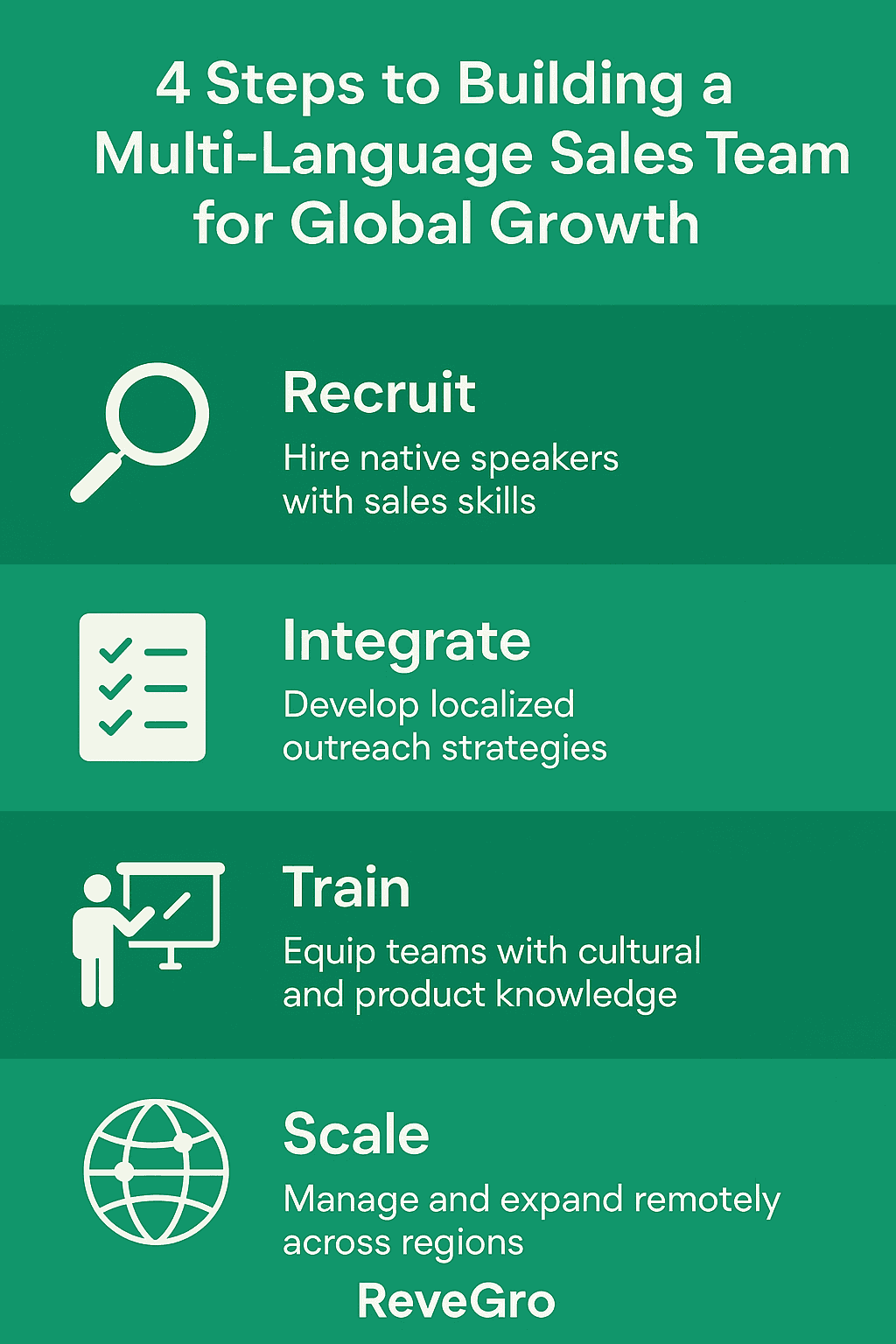
To grow internationally, focus on building multi-language sales teams by recruiting native speakers, integrating localised outreach, training them on your market and product, and scaling via remote management.
This approach drives faster pipeline growth in key regions like Europe, LATAM, and APAC.
Why Multi‑Language Sales Teams Matter for Global Growth
Native-language engagement builds trust and rapport more quickly.
Cultural fluency enables representatives to handle local objections effectively.
Regional targeting unlocks new sales motions in untapped markets.
Companies that use this strategy often see conversion rates 20–30% higher on regional campaigns.
Brands expanding beyond their home market frequently struggle without properly tailored sales efforts. That’s where multi-language sales teams make a difference—turning leads into loyal customers faster.
What Happens Without Native-Language Outreach?
Your message may come across as generic or tone-deaf across cultures.
Missed responses from prospects who prefer native-language communication.
Competitive disadvantage in countries like France, Germany, Spain, and Brazil.
Scaling beyond English-speaking regions becomes slow and reactive.
What Advantages Do Multi‑Language Sales Teams Offer?
1. Higher Conversion Across Borders
Speaking in a prospect’s native language immediately boosts engagement and credibility.
2. Culturally-Informed Sales Tactics
Local representatives understand regional nuances, from pricing sensitivities to compliance requirements.
3. Tailored Messaging for Each Region
From lead magnets to discovery calls, every touchpoint is localised for maximum impact.
4. Faster Deal Cycles
Native-language communication simplifies negotiation and speeds up closure timelines.
What Roles Should Your Multi‑Language Team Include?
Role | Responsibility | Language Focus |
SDRs | Cold outreach, lead qualification | German, French, Spanish, etc. |
BDRs / AMs | Pipeline nurturing and deal closing | Native-language engagement |
Sales Manager | Oversight, coaching, performance tracking | Bilingual or multilingual |
A well-structured multilingual team ensures that lead generation and deal execution are both culturally and linguistically aligned.
In‑House vs Freelancer vs Outsourced Sales Team for B2B
Model | Time to Launch | Cost | Language Quality | Management Overhead |
In-House Hires | Slow | High | Very High (if hired well) | High |
Freelancers | Fast | Low–Medium | Variable | Medium |
Outsourced Sales Team for B2B | Fast | Medium | Consistent, Vetted | Low (with provider support) |
In-house hires offer control but are costly and slow to onboard.
Freelancers are quick, but quality and continuity can suffer.
An outsourced sales team for B2B growth provides scalable, language-native talent with built-in processes, perfect for lean international scaling.
How to Recruit and Vet Multilingual Sales Talent
1. Test Cultural and Language Fluency
Role-play international calls and read/write scenarios in the native tongue.
2. Practical Skills Assessment
Request sample cold emails in the target language and a mock pitch to assess proficiency.
3. Compliance and Remote Work Readiness
Ensure proper contracts, tax setups, and remote tools are in place.
4. Native-Language Onboarding
Equip teams with localised materials and context to drive better regional performance.
Managing Remote Sales Teams Europe and Beyond
Essential Tech Stack
CRM with language-specific tagging and dashboards
Recording tools (e.g., Gong) with native-language transcription
Regional communication channels (Slack/MS Teams by language group)
Standardised, Localised Playbooks
Create email, call, and demo scripts tailored to each country.
KPIs by Region
Analyse performance by market: leads booked, demos, and conversion rates.
Coaching and Quality Assurance
Conduct call reviews and feedback sessions in each native language to ensure consistency and maintain skills.
How to Launch with a Lean Lingual Sales Blueprint
Prioritise regions based on addressable market and product fit
Create outreach cadences per language (calls + emails + LinkedIn touches)
Pilot with outsourced teams, targeting two or three languages simultaneously
Measure KPIs after 60 days: response rates, demos booked, pipeline buildup.
Scale successful campaigns and gradually add new language markets
This phased approach avoids heavy investment until the strategy is proven to work.
How ReveGro Empowers Global Sales Growth
ReveGro excels in delivering scalable, native-language sales capabilities:
Multilingual SDR provision: Fluent in German, French, Spanish, Italian, and more.
Remote Sales Teams Europe and beyond: Operates from UK, Spain, and Singapore offices for global reach.
Outsourced Sales Team for B2B excellence: Full-time SDRs, playbook-driven, plug-and-play model integrates with your roadmap.
Cloud-enabled collaboration: CRM setup, team leads, KPI tracking, and monthly insight reports ensure performance and alignment.
Which KPIs Should You Track for Multi‑Language Sales Teams?
To accurately assess performance across language-specific markets, monitoring a regional KPI framework ensures consistent, data-driven growth.
Key Metrics to Measure by Language/Region
Conversion Rate / Win Rate per Region - Tracks how many opportunities turn into closed deals in each language market.
Sales Cycle Length by Territory - Measures the average time from initial outreach to deal closure.
Pipeline Velocity - Combines win rate, average deal size, and sales cycle length to gauge how quickly revenue is generated per market.
Activity Metrics by Language Group
Track regional performance in:
Calls or messages sent
Meetings booked
Demos held
Lead response time
Lead Conversion Rates per Stage - Monitor conversion from MQL to SQL, SQL to opportunity, and opportunity to close separately for each language team.
Average Deal Size & ACV by Region - Track the average contract value and revenue per closed deal, as it may vary significantly across markets.
Why Segmented KPIs Matter
Reveals performance disparities between language markets, enabling targeted training or adjustments
Helps forecast revenue more accurately by considering market-specific sales cycle velocity
Supports data-driven decisions for expansion strategies
Aligns cross-region teams toward unified OKRs, fostering clarity and accountability
How Can AI Personalization Strengthen Buyer Relationships?
Buyers don’t want generic outreach, they want relevant, human-sounding communication. AI makes personalization scalable.
AI personalization includes:
Custom subject lines: AI tools analyze recipient behavior to write subject lines that boost open rates.
Dynamic content: Websites adapt messaging based on visitor industry or role.
Tailored presentations: AI tools help reps design decks focused on each client’s pain points.
When personalization is done right, prospects feel understood, not just targeted.
Which Parts of the Sales Process Can AI Support?
AI supports nearly every stage of the sales cycle:
Prospecting: Find and validate new accounts.
Qualification: Score and prioritize the best-fit leads.
Outreach: Automate follow-ups across email, LinkedIn, and chat.
Pipeline management: Forecast deal progression and close probability.
Customer success: Predict churn risk and identify upsell opportunities.
Manual Sales Efforts vs. AI-Augmented Sales

Can AI Replace Salespeople, or Just Support Them?
A common question is whether AI will replace human reps. The answer is no.
AI handles: repetitive tasks, data crunching, and early qualification.
Humans handle: trust-building, negotiation, and closing.
The future of sales is not AI vs. people, it’s AI + people. AI amplifies sales teams by giving them more time for high-value conversations
How SMEs Can Adopt AI Without Heavy Investment
Many SMEs assume AI is too expensive. But entry barriers are lower than ever.
Practical steps for SMEs:
Start small: Use low-cost AI prospecting tools (Apollo, Lemlist AI, HubSpot AI).
Leverage CRM AI features: Salesforce Einstein, Zoho Zia, and HubSpot AI are affordable add-ons.
Test one use case: Lead scoring or AI email personalization is a quick win.
Outsource when needed: Agencies like ReveGro use AI as part of their lead generation services, giving SMEs access without setup costs.
An SME in professional services used outsourced SDRs with AI qualification. In six months, they built a £2M pipeline without hiring a new representative, similar to the approach described in our blog How can I grow my sales pipeline without hiring more salespeople.
What Are the Risks and Limitations of AI in Sales?
AI is powerful, but it has its downsides if misused:
Over-automation: Risk of robotic outreach if humans aren’t involved.
Data privacy: Mishandling customer data can lead to GDPR fines.
Bias in AI models: Poor data leads to skewed results.
Human oversight is essential: AI needs monitoring to stay effective and ethical.
What’s the Future of AI in Sales?
AI is just getting started. The next wave will include:
Predictive timing: AI will suggest not only who to call, but when.
Voice AI: Conversational bots handling initial calls before handoff to humans.
Real-time coaching: AI guiding reps during live sales calls.
End-to-end integration: Sales, marketing, and customer success unified by AI.
By 2030, AI won’t just assist sales, it will shape how sales strategies are designed. This aligns with the principles outlined in What’s the best way to increase the value of my company.
How ReveGro Combine AI With Human Sales Expertise
At ReveGro, we’ve found that the sweet spot is blending AI insights with human execution.
AI-driven lead qualification: We enrich and score leads so only the best reach your reps.
Automation at scale: Our systems manage outreach campaigns across channels.
Human SDRs: Our multilingual SDRs add the personal touch AI can’t replicate.
Proven impact:
A telecom client saw conversion rates jump from 6% to 23%.
A SaaS firm cut qualification time by 35% and added £5M to its pipeline.
With ReveGro, businesses don’t have to choose between AI and people, they get both, working together for maximum impact.
Final Thoughts
AI isn’t here to replace sales teams, it’s here to amplify them.
AI for lead generation saves time by surfacing ready-to-buy prospects.
B2B lead qualification AI improves efficiency by filtering out poor-fit leads.
AI sales automation in UK scales outreach while staying GDPR-compliant.
The future belongs to companies that combine AI with human expertise.
To apply this in practice, businesses can use ReveGro’s Growth Acceleration service.
FAQs
What’s the difference between AI for lead generation and AI sales automation?
Lead generation AI identifies prospects, while sales automation AI manages outreach and follow-ups. Together, they streamline the entire sales cycle.
Is AI sales software expensive for SMEs?
Not anymore. Many tools start at £50–£200/month, and agencies offer AI-powered lead generation as a service for predictable costs.
How can AI improve personalization without sounding robotic?
AI personalizes based on data (industry, behavior, intent), but humans still refine the tone to keep communication natural.
What’s the best first step to adopting AI in sales?
Start with B2B lead qualification AI for scoring or AI sales automation for email sequencing, it delivers quick, measurable wins.